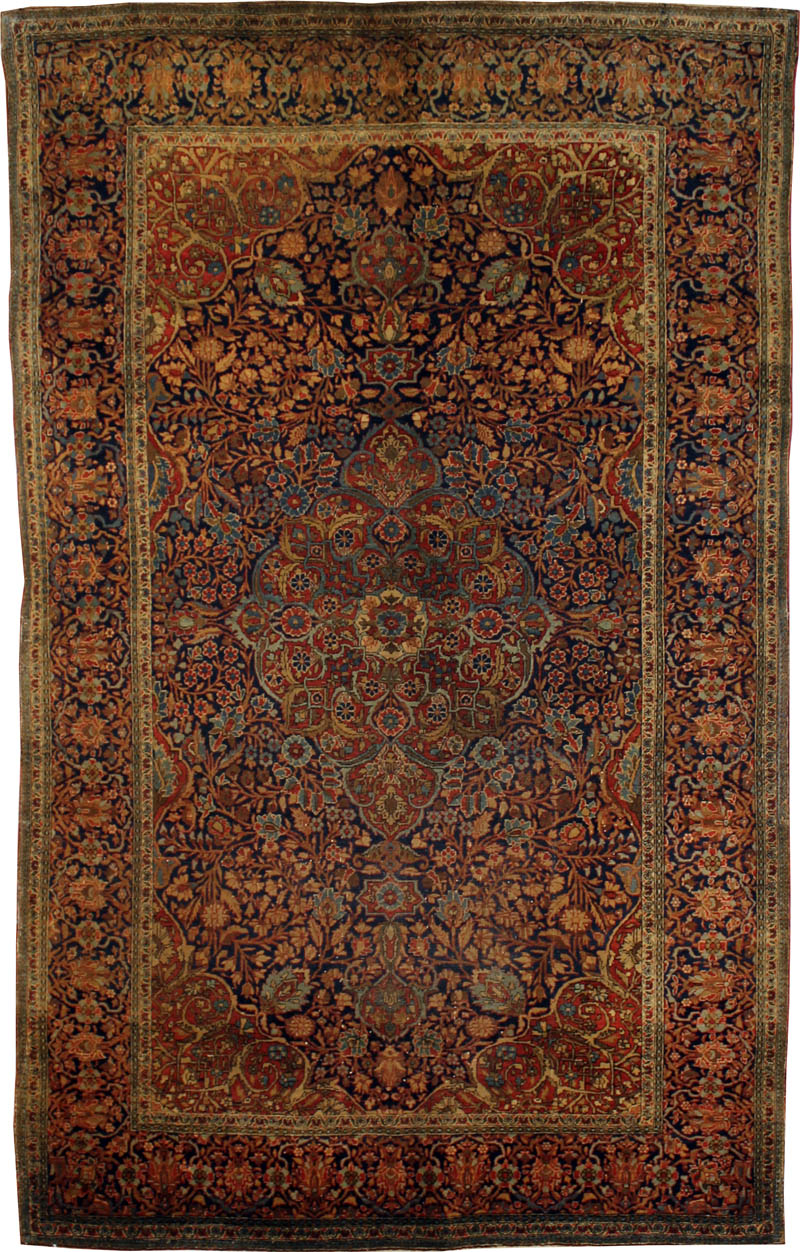
Antique Persian Atashoghlou Rug
Size: 4'3" × 7'
Date: Early 1800s
Material: Wool on Cotton
Atashoghlou is a village in the Farahan district of west-central Iran, and rugs bearing this name are among the most sought-after of all 19th-century Persian village weavings. Production was limited, quality was consistently high, and examples from the early 1800s are genuinely rare — this piece is over two centuries old.
The deep indigo field is anchored by a large central medallion of lobed, cartouche form filled with intricate floral scrollwork in madder, camel, sky blue, and sage green. The surrounding field is dense with curving vines, large palmettes, blossoming flower heads, and scrolling leaves that extend to every corner without a single area left unresolved. The drawing throughout is fine and confident — the vine work maintains consistent weight across the whole field, and the individual floral forms are fully detailed rather than abbreviated. Matching corner spandrels in madder echo the medallion and pull the composition together.
The wide navy border carries its own elaborate floral meander, rich enough to read as a composition in its own right. Two centuries of age have mellowed the natural dyes to a warm, complex depth — the indigo has shifted toward a rich blue-black, and the madder tones have softened to a burnt auburn — producing the kind of patina that simply cannot be replicated.
At this age and from this specific origin, pieces in collectible condition are rarely encountered.