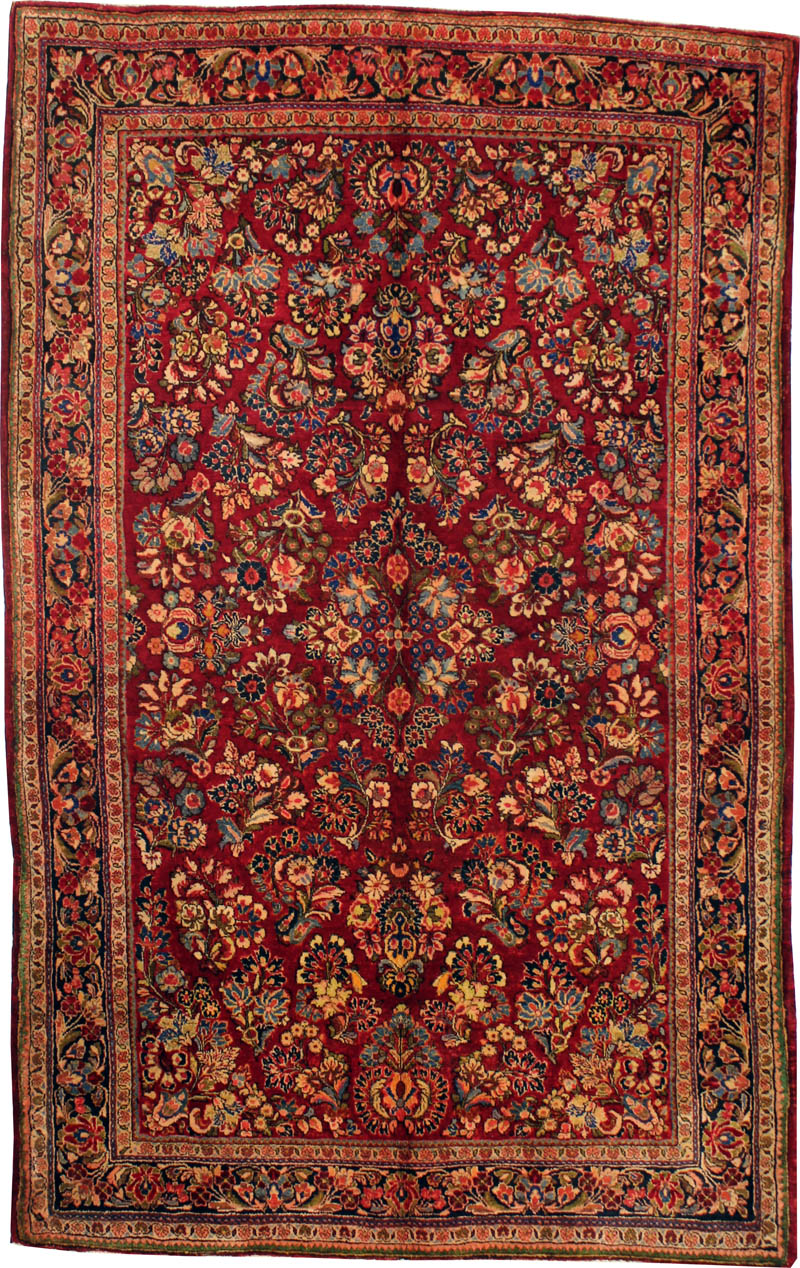
Antique Persian Sarouk Farahan Rug
Size: 4' × 6'4"
Date: 1890s
Material: Wool on Cotton
The Farahan district of west-central Iran produced some of the finest village rugs of the 19th century, and the Sarouk Farahan designation identifies pieces from this area that combine the refined floral drawing of Sarouk with the slightly more open, naturalistic composition associated with Farahan weaving. Examples from the 1890s predate the commercial Sarouk production that dominated the early 20th century and are considerably more individual in character.
The deep crimson field is covered with a lush, symmetrical all-over floral design — large blossoming flower heads, curving leafy vines, and full palmettes spreading outward from a central vertical axis without a formal medallion. The composition is dense but not crowded, with enough field colour showing through to give the pattern breathing room. The drawing has the slightly looser, more naturalistic quality that distinguishes Farahan work from the more tightly controlled Kashan style.
The colour range is exceptional for a piece of this age — ivory, sky blue, gold, olive green, and dusty rose all register clearly against the crimson ground, and the naturally dyed wool has developed a warm patina without any significant fading. The navy border carries a continuous floral meander that frames the field with appropriate weight.
A finely drawn and well-preserved piece from one of the most respected village weaving traditions in Persia.